Keeping Your Cool: RV Air Conditioner Troubleshooting
There is nothing worse than pulling into a sunny campsite, cranking up the AC, and getting blasted with warm air. When you're parked in direct sunlight, a motorhome can turn into an oven in minutes. Understanding how your cooling system operates helps you spot minor issues before they turn into expensive repairs.
While complex electrical or refrigerant problems require a professional motorhome repair service, you can easily troubleshoot several common issues on your own.
Running Your AC on Generator Power: Electrical Load Management
Many owners encounter air conditioning issues when trying to run their units away from shore power. Your air conditioner consumes more electricity than almost any other appliance in your vehicle. Managing this electrical load incorrectly can cause your unit to shut down or damage its electrical components.
An air conditioner requires starting wattage (the brief surge to start the compressor) and running wattage (the steady power to keep it going). If you are boondocking, your generator must handle both.
To keep from tripping breakers, keep an eye on these specific power draws:
Total Wattage Capacity: A standard 13,500 BTU RV air conditioner requires about 2,800 to 3,000 watts to start and 1,500 to 2,000 watts to run.
Competing Appliances: You cannot run everything at once. A microwave uses 1,000 to 1,500 watts, while an electric water heater draws around 1,400 watts.
The Power Converter: Your onboard converter constantly draws 300 to 800 watts to charge your house batteries.
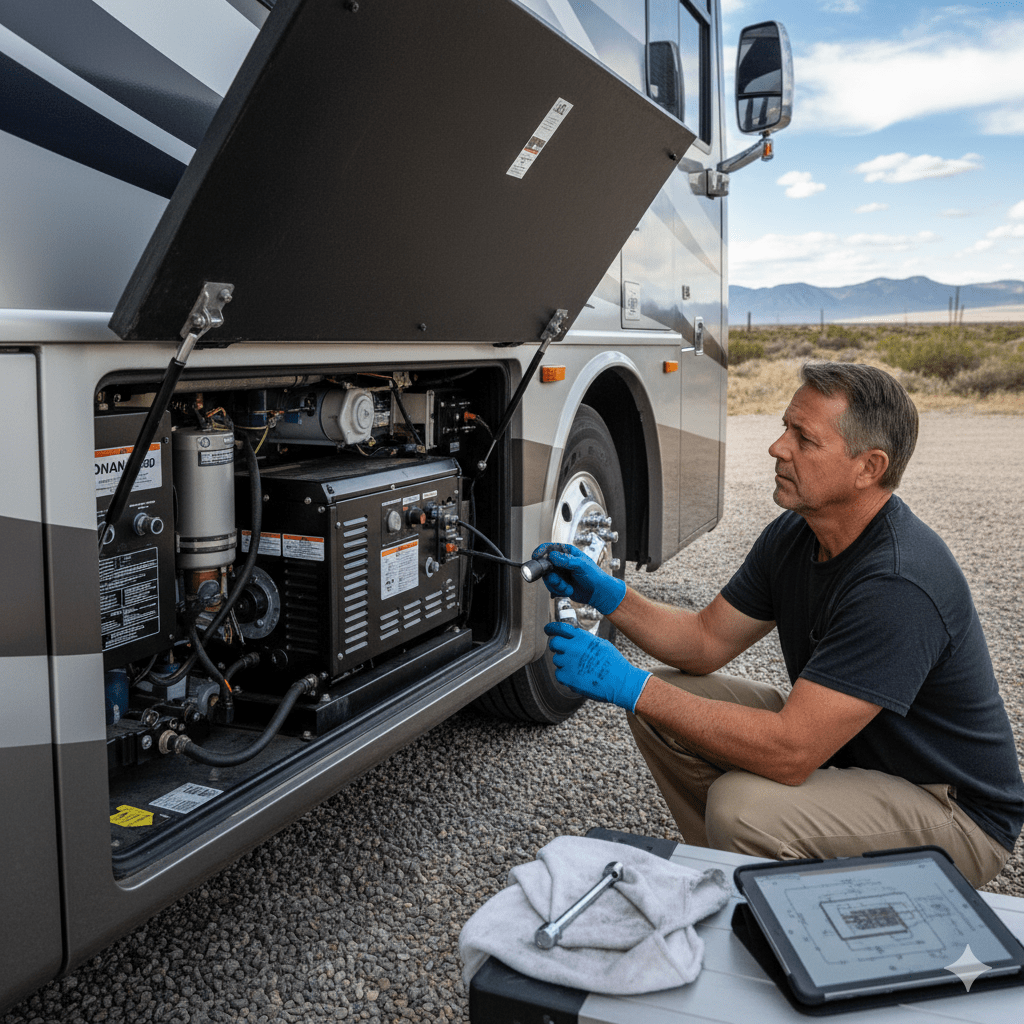
When your generator stalls, surges, or chokes the second the AC kicks on, the issue is likely under the generator's hood. Staying on top of regular maintenance is what keeps your power source responsive. If you notice erratic power delivery, you may need a professional Onan generator repair to clean the carburetor, adjust the governor, or replace worn parts.
Why Your RV AC Freezes Up: Airflow vs. Low Refrigerant
If you notice the airflow dropping or the cabin getting warmer by the hour, take a look at the unit; it might actually be frozen. Once ice builds up on those cooling coils, it chokes off the airflow entirely. While owners often assume low refrigerant is the culprit, a lack of adequate airflow is the most common cause of ice.
The Role of Airflow
Your air conditioner pulls warm, humid air from your cabin across cold evaporator coils. If air moves too slowly, the moisture condensing on the coils drops below 32 degrees Fahrenheit and turns to ice.
Common airflow issues include:
Low Fan Speed: Running your fan on "Low" during highly humid days can freeze the coils.
Closed Registers: Closing too many ceiling vents restricts the volume of air moving through the system.
A Misaligned Air Divider: If the thin foam divider separating the warm return air from the cold supply air slips out of place, cold air leaks directly back into the return side.
Low Refrigerant Levels
If your filters are clean, your vents are open, and your fan is running on high, you may have low refrigerant. Modern RV air conditioners are sealed systems that do not consume refrigerant over time. A low level means a physical leak exists.
Unlike a home system, you cannot simply add more Freon because RV units lack service ports. Fixing a leak requires a certified RV repair shop to cut into the lines, install service valves, patch the leak, and recharge the system.
The Fan Hums but Won't Spin: Checking the Capacitor
If you turn on your thermostat and hear a humming sound from the roof but no air blows through the vents, you are likely dealing with a failed capacitor.
Think of capacitors as tiny batteries that store up electricity and dump it in a quick burst to kick-start those heavy motors. Between blistering summer heat and sudden power surges, these parts take a beating over time. When a capacitor fails, the fan motor sits in place and emits a low electrical hum.
You can perform a quick visual inspection:
Disconnect Power: Turn off the air conditioner at the thermostat, shut off the main breaker inside the RV, and unplug the shore power cord.
Remove the Shroud: Go onto the roof of your vehicle and remove the plastic outer cover of the AC.
Locate the Electrical Box: Open the metal access panel protecting the wiring.
Inspect for Damage: A healthy capacitor is a perfect cylinder. If the top is bulging, domed, or leaking oily fluid, the component has failed and must be replaced.
Capacitors can hold a dangerous electrical charge even after you disconnect the power. If you are uncomfortable handling high-voltage components, it is safest to bring your vehicle to a professional RV repair shop.
Maximizing Efficiency: Cleaning the Filter and Evaporator Coils
Regular preventative maintenance is the simplest way to extend the lifespan of your cooling system. Dust, pet dander, and outdoor debris create a thermal barrier that reduces cooling efficiency.
Cleaning the Return Air Filter
Your return air filter sits just behind the ceiling grill inside your living space. Inspect this filter every two weeks during periods of heavy use.
Remove the plastic grill cover.
Take out the foam or mesh filter element.
Wash the filter in a sink using warm water and mild dish soap.
Allow the filter to dry completely before reinstalling it.
Cleaning the Coils
Your system contains two sets of metal fins that must remain clean: the evaporator coils inside the vehicle and the condenser coils on the roof.
Evaporator Coils: Access these from inside the cabin or by removing the internal shroud on the roof. Gently vacuum away loose dust and spray self-rinsing coil cleaner onto the aluminum fins.
Condenser Coils: Located on the roof, these coils gather leaves, dirt, and insects. Spray them with a heavy-duty coil cleaner, let it sit for ten minutes, and rinse the fins gently with a low-pressure garden hose. Never use a high-pressure power washer, as it will bend the delicate aluminum fins.
Contact Our RV Repair Shop Today
Chasing down AC problems gets complicated fast, especially when you start messing with rooftop wiring, control boards, or sealed lines. Plus, letting a malfunctioning unit run can overheat the compressor, turning a cheap fix into a massive replacement bill.
If your motorhome stays warm despite your troubleshooting efforts, the experienced technicians at Mainline RV & Truck Service are ready to assist you. We operate a 16,000-square-foot facility equipped with modern diagnostic tools to handle everything from standard maintenance to complex electrical overhauls.
Don't let a failing air conditioner ruin your summer travel plans. Contact Mainline RV & Truck Service today to schedule your service appointment.
Contact Us